t’s 22 years since Spielberg’s original adventure, but does the fourth movie in the series have teeth? Critic Nicholas Barber gives his verdict.
Jurassic Park is open for business – and it’s about time, too. It was always a let-down that the first two sequels to Steven Spielberg’s original film were set in an uninhabited jungle environment, rather than the fully-functioning theme park promised by the title. Partly it was disappointing because a new setting would have moved the story on, whereas the sequels were essentially remakes of 1993’s blockbuster. But mainly it was disappointing because it made no sense. I mean, why hadn’t the park opened its doors? True, it had had a few teething problems, mostly involving Tyrannosaurus Rex teeth, but come on: an island stocked with real, live dinosaurs? Who wouldn’t want to go there?
Twenty-two years on, Jurassic World is finally up and running. Located on a lushly forested island off the coast of Costa Rica, it’s a luxurious, high-tech resort which lets visitors feed a Stegosaurus and ride a Triceratops. You can get splashed by a whale-sized Mosasaurus as it leaps from its Seaworld-like tank to swallow a shark in one gulp, and then the hydraulic seating will lower you for an underwater view. You can even go on safari through a grazing herd of Apatosauruses, not in a Jeep, but in some kind of motorised perspex ball. The hotel rooms look nice, too.
As for the film, it’s not unlike a theme park itself. Directed and co-written by Colin Trevorrow, with an executive producer credit for Spielberg, Jurassic World is a bright, shiny, breathtakingly efficient entertainment machine that serves up spectacular, family-friendly excitement. Like most theme parks, it exists to transfer money out of your pocket and into a corporate bank account, but it does so with so much flair that you can hardly resent it.
Mind you, you don’t go to a theme park to enjoy its attendants’ rich personalities, and that applies to Jurassic World, too. The park’s general manager is Claire (Bryce Dallas Howard), a beautiful yet buttoned-up bean counter who keeps saying that the resort needs to be more profitable. Just to make sure we appreciate how cold-hearted she is, she uses the words “focus group”, “assets”, and “shareholders” in every other line of dialogue. Claire has even authorised the creation of a gene-spliced hybrid mega-Tyrannosaur, the Indominus Rex, because tourists are supposedly getting tired of the boring, run-of-the-mill variety. Personally, I’m not sure which is more implausible, the notion that people would ever get blasé about a 40-foot-high, formerly extinct reptile or that a theme park would try to boost its revenue in such a wildly risky way. But there is another, more compelling reason for the genetic-engineering. Borrowing an idea from the Alien films, Claire’s snarling boss, Hoskins (Vincent D’Onofrio), sees the modified dinos as potential weapons of war.
‘B-movie thrills’
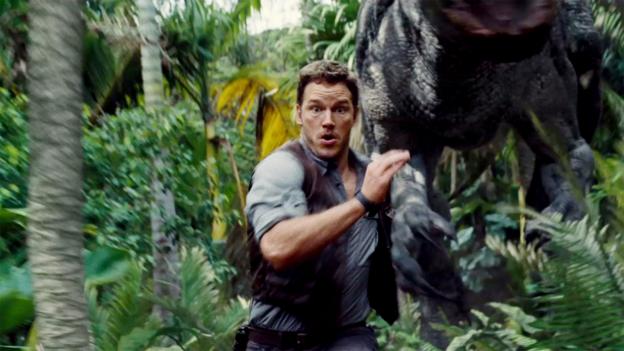
Unsurprisingly, the I-Rex escapes from its enclosure and runs rampage across the island: unsurprisingly, that is, because it is a super-intelligent predator that can change colour and lower its temperature at will. What were the scientists thinking? To make matters worse, two boys have chosen that exact moment to wander off and get lost in the park’s wild outskirts – and they happen to be Claire’s nephews. The only person who can save the day is her ex-boyfriend, Owen (Chris Pratt), a hunky, unshaven, vintage motorbike-riding US Navy veteran who has somehow re-trained as a Velociraptor whisperer. If he can bring the I-Rex to heel, then, who knows, maybe he can thaw the frosty Claire while he’s at it.
As charming as Pratt is, the film’s human characters are no more rounded than the dinosaurs. And, as far as their gender roles are concerned, they’re almost as prehistoric. Owen is a goodie, Hoskins is a baddie, the two boys are two boys, and Claire, like a zillion movie heroines before her, makes the inevitable transition from icy rule-follower to feisty action-woman – although she keeps her stiletto heels on, even when she is sprinting away from a hungry Tyrannosaur. Still, you could argue that the film’s black-and-white characters are in keeping with its old-fashioned, B-movie thrills – and it certainly has plenty of those. Once it gets past its convoluted opening, Jurassic Park is one of the most deft blockbusters of recent years. It keeps up its whirlwind pace, it keeps up its jokes and twists and it keeps finding new ways to vary its basic dodge-the-dino scenario. Considering how witless so many recent effects-driven movies have been – San Andreas being the latest example – it’s a pleasure to see one that knows what it’s doing.
To put it another way, Jurassic World has the joyous energy and the lucid storytelling you might associate with Spielberg, which is clearly what Trevorrow and his three co-writers had in mind. The film isn’t just assembled with Spielberg’s signature attention to detail, it’s studded with nods and winks to his back catalogue: when it’s not making in-jokes about the first two Jurassic Park instalments, it’s throwing in references to Jaws and ET: The Extra Terrestrial. The most endearing thing about Jurassic World is Trevorrow’s sincere, nerdish devotion to his executive producer, which bursts from every frame. It’s obvious that he was motivated by his passionate desire to do Spielberg proud. But the film might have been even more engaging, and less like a theme park, if its characters had some of that emotion, too.

No comments:
Post a Comment